
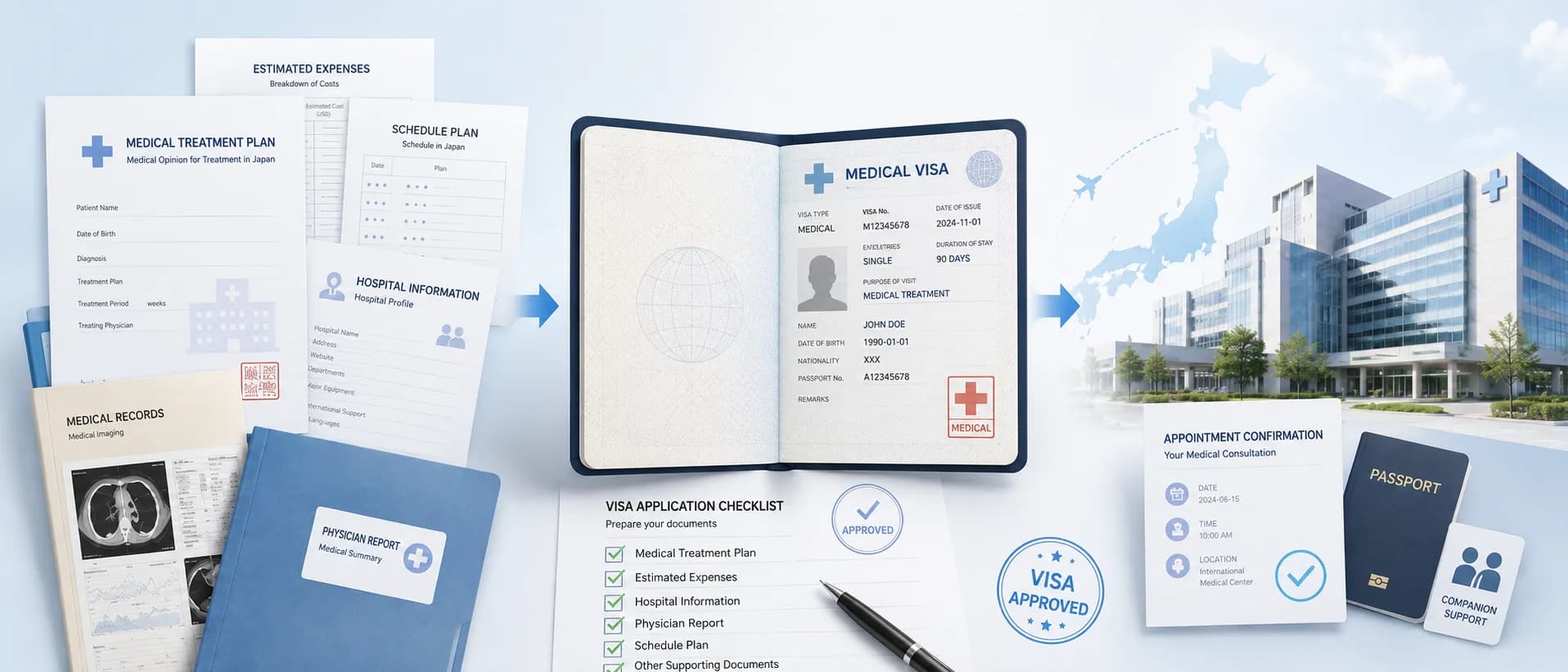
Medical Visa JP
Medical Visa Application Process
What Is a Visa for Medical Stay?
A Visa for Medical Stay is issued to foreign patients who wish to visit Japan for medical treatment, examinations, health checkups, dental care, recuperation, or other medical purposes. Where necessary, the visa may also be issued to accompanying persons.
Eligible services include inpatient and outpatient treatment, comprehensive medical checkups, health examinations, diagnostic testing, dental treatment, and recuperation prescribed or recommended by a Japanese medical institution, including hot-spring recuperation for a period of up to 90 days.
How Long Can I Stay in Japan?
Visas for Medical Stay may be issued as either single-entry or multiple-entry visas. They are generally categorized as follows:
Single-entry visa
Multiple-entry visa valid for one year
Multiple-entry visa valid for three years
A single-entry visa generally allows one entry into Japan. A multiple-entry visa allows the patient to enter Japan several times during the visa’s period of validity.
However, a multiple-entry visa may be issued only when each stay in Japan is 90 days or less. A Medical Treatment Plan prepared by a physician in Japan is required when applying for a multiple-entry visa.
Depending on the patient’s medical condition, treatment plan, and other relevant circumstances, the authorized period of stay may be 90 days, six months, or one year.
When the planned stay exceeds 90 days, hospitalization at a Japanese medical institution is generally required. In such cases, the patient must obtain a Certificate of Eligibility through a staff member of the admitting medical institution or an eligible family member residing in Japan.
What Type of Visa Is Issued to an Accompanying Person?
Where necessary, an accompanying person may be issued the same Visa for Medical Stay as the patient.
The accompanying person does not have to be a relative. A family member, relative, friend, or another suitable person may accompany the patient when necessary.
The purpose of the accompanying person’s visit must be to provide personal care and everyday assistance to the patient. Accompanying persons are not permitted to engage in paid employment, income-generating business activities, or other remunerated activities in Japan.
How Do I Apply for a Visa for Medical Stay?
The application process generally consists of three main steps.
1. Decide Whether to Receive Treatment in Japan
Patients should not travel directly to Japan before confirming that a medical institution is able to accept them.
If a patient arrives in Japan without prior acceptance and the hospital is unable to provide the requested treatment, valuable time and expenses may be lost. In some cases, this may also delay access to appropriate treatment.
Patients are therefore advised to arrange a written consultation, online consultation, or second medical opinion with the preferred hospital or specialist before traveling.
After the physician has reviewed the patient’s condition, proposed a treatment plan, and confirmed that the medical institution can accept the patient, the patient and family can decide whether treatment in Japan is appropriate for them.
These arrangements should generally be made through a registered guarantor, such as an authorized medical coordinator or travel agency participating in Japan’s medical-stay visa scheme.
2. Obtain the Required Documents from Japan
Once the receiving medical institution has been confirmed, the patient should obtain the required documents through the registered guarantor. These generally include:
A Certificate of Scheduled Medical Services issued by the receiving medical institution
A Letter of Guarantee issued by the registered guarantor
A Medical Treatment Plan prepared by a physician
Required when applying for a multiple-entry visaA schedule of stay and any other documents required by the Japanese diplomatic mission handling the application
The exact documents required may vary depending on the patient’s nationality, country of residence, medical condition, planned period of stay, and the type of visa being requested.
3. Submit the Visa Application
After the Japan-side documents have been prepared, the patient may submit the application through the Japanese Embassy or Consulate-General with jurisdiction over the patient’s place of residence, an accredited application agency, or an authorized visa application center.
The required documents generally include:
Passport
Visa application form
Photograph
Certificate of Scheduled Medical Services issued by the medical institution
Letter of Guarantee issued by the registered guarantor
Evidence of sufficient financial resources, such as a bank balance certificate
Documents confirming the applicant’s identity
Medical Treatment Plan
Required when applying for a multiple-entry visaCertificate of Eligibility
Required when the patient will be hospitalized and needs to stay in Japan for more than 90 days
Application procedures and required documents may differ depending on the country or region in which the application is submitted. Applicants should always check the latest requirements published by the relevant Japanese Embassy or Consulate-General.
Frequently Asked Questions About the Visa for Medical Stay
Q: I already have a tourist visa. Do I still need to apply for a Visa for Medical Stay?
A tourist visa is primarily intended for travel and sightseeing, whereas a Visa for Medical Stay is specifically intended for medical treatment, examinations, health checkups, or recuperation in Japan.
Holding a tourist visa does not automatically mean that a separate medical visa is unnecessary. The appropriate visa depends on the principal purpose of the visit, the nature and duration of the treatment, whether hospitalization is required, and the conditions attached to the visa already held.
Patients should confirm their individual circumstances in advance with the relevant Japanese Embassy or Consulate-General, the receiving medical institution, and the registered guarantor.
When traveling under a Visa for Medical Stay, patients should also provide the guarantor with their flight number, arrival and departure schedule, and other travel information as requested.
Tips for Chinese Patients Seeking Medical Treatment in Japan
Preliminary Medical Assessment
Before receiving treatment at a Japanese medical institution, the patient must first undergo a preliminary assessment to determine whether the hospital can accept the case and whether the requested treatment is medically appropriate.
The patient should prepare relevant medical information, including:
Medical history
Medical records
Diagnostic and laboratory test results
Medical imaging data
Pathology reports
Current symptoms
Previous treatments
Medication history
These materials are translated into Japanese and submitted to the appropriate Japanese medical institution. A specialist then reviews the information and evaluates whether the patient is suitable for treatment and whether the institution can accept the case.
If the patient is considered suitable and the hospital confirms acceptance, the patient will generally receive information regarding the proposed treatment plan, expected schedule, and estimated medical costs.
If the hospital is unable to accept the patient, it may provide the reasons for its decision and, where appropriate, suggest alternative treatments or other medical institutions.
Arranging the Necessary Procedures
Once the preliminary assessment has confirmed that the treatment is appropriate and the medical institution has formally agreed to accept the patient, the following arrangements can begin:
Visa for Medical Stay application
Flight arrangements
Accommodation arrangements
Airport transfers
Transportation within Japan
Medical interpretation
Coordination of consultations, treatment, and hospitalization
Daily life support during the patient’s stay in Japan
We provide comprehensive assistance from pre-departure preparation through medical care and daily life support in Japan, helping patients and their families focus on treatment with greater confidence and peace of mind.